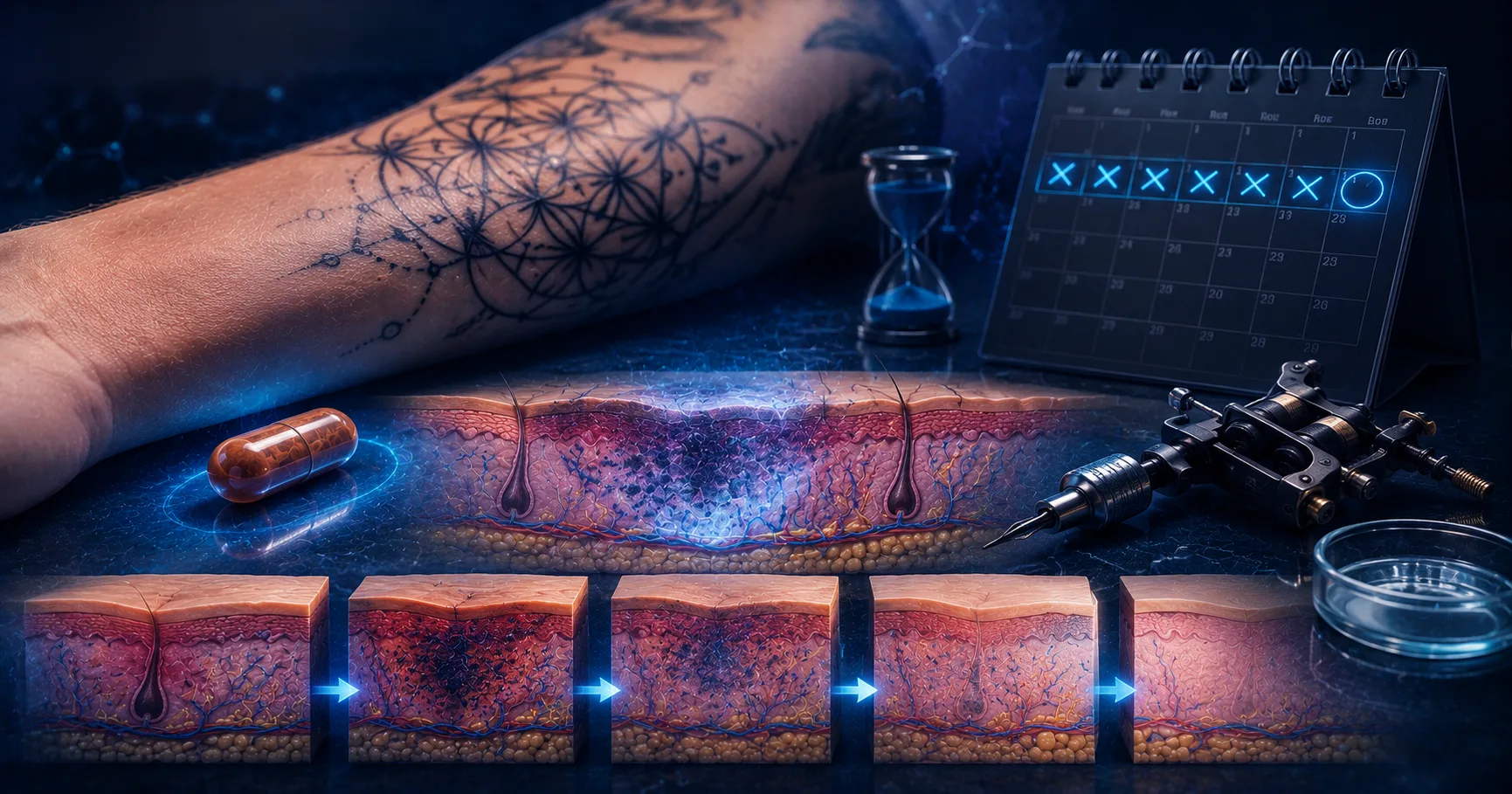
Accutane and Tattoos: Skin Risks, Healing, and Timing
Can you get a tattoo on Accutane? Dermatologists say no — here's why isotretinoin raises scarring risk and exactly how long to wait after stopping.
How Isotretinoin Rewires the Skin That Tattoos Depend On
Accutane and tattoos is a combination that dermatologists and experienced tattoo artists both actively warn against — and the reasons go deeper than dry, flaky skin. The effects of isotretinoin on skin are structural, not superficial.
Isotretinoin works by dramatically shrinking the sebaceous glands responsible for excess oil production. During a typical course, sebum production drops by up to 90% and sebaceous gland size decreases by 35–58%. These are the drug's primary mechanisms against severe acne — but they also mean the skin's barrier function, moisture retention, and structural integrity are significantly compromised for the entire duration of treatment.
For tattooing, this creates real, measurable problems. A tattoo needle punctures the skin thousands of times per minute, depositing ink into the dermis. That process depends on three things that isotretinoin directly disrupts:
- 1Normal stratum corneum thickness — isotretinoin thins the outermost protective skin layer, reducing its ability to contain ink precisely at the deposit site
- 2Functional wound healing — the body needs to clot, seal, and rebuild after tattooing; isotretinoin impairs this process at the cellular level
- 3Adequate sebum production — natural skin oils are critical to the early-phase healing of a fresh tattoo
None of these conditions exist in an intact form while you're taking isotretinoin. That's not a theoretical risk — it's physiology.
Isotretinoin cuts sebum production by up to 90% during treatment. Even in your final weeks on the drug, your skin barrier is operating at a fraction of its normal capacity. Wait until sebaceous function has recovered — not just until the drug feels "done."
The Ink Migration Risk No Competitor Mentions
One specific complication from getting a tattoo while on accutane almost never appears in mainstream health content: ink migration, also called a tattoo blowout.
When the stratum corneum is thinned by isotretinoin, the density of the skin at the dermis-epidermis junction changes. Tattoo needles deposit ink at a calculated depth — but on compromised skin, that ink can spread laterally beyond the intended lines. The result is a permanent design distortion: fine lines that blur, edges that look smeared, and detail work that becomes an indistinct shadow within weeks of healing.
This isn't a temporary side effect. It doesn't resolve when isotretinoin clears your system. The pigment migration is locked in.
For precision work — script, fine-line designs, geometric patterns, small portraits — this is potentially catastrophic. Even simple bold tattoos can develop uneven, blurry edges if the stratum corneum isn't structurally sound during the healing phase.
Accutane tattoo healing, when it happens at all during treatment, frequently produces suboptimal pigment retention alongside this migration risk. The skin cannot manage both the drug's systemic effects and the precise dermal conditions a fresh tattoo requires. Laser correction for blowouts is possible but expensive, difficult, and never fully guaranteed — avoidance is the only reliable answer.
What Happens If You Start Accutane With a Fresh Tattoo
No top competitor addresses this scenario: you get a tattoo, then your dermatologist starts an isotretinoin course a few weeks later before the tattoo is fully healed.
Tattoo healing happens in layers. The surface looks healed within 2–4 weeks, but the deeper skin remodels for 3 to 6 months. Starting isotretinoin during that subsurface healing phase creates compounding problems:
- 1Sebum suppression interferes with the reforming epidermal barrier over the new tattoo
- 2Ink retention may be permanently compromised as the healing skin struggles to consolidate deposited pigment
- 3Infection risk increases as isotretinoin alters local skin immune responses
- 4The tattoo's final color saturation and edge definition may be affected in ways that only become visible months later
If you have a recent tattoo and your dermatologist is starting you on isotretinoin, disclose when it was done. Ideally, a tattoo should be fully settled for at least 3 months before beginning an isotretinoin course.
Frequently Asked Questions
No. Isotretinoin compromises the skin barrier, disrupts wound healing, and elevates the risk of ink migration, infection, and keloid scarring throughout the entire treatment course. Reputable tattoo studios formally refuse clients who disclose current isotretinoin use, regardless of how the skin looks on the day.
Clinical dermatology guidelines recommend waiting a minimum of 6 months after your last dose before pursuing tattoo after accutane. The drug clears pharmacokinetically in about 1 month, but structural skin recovery — sebaceous gland regrowth, collagen normalization, epidermal barrier restoration — takes considerably longer. Six months is the clinical minimum, not a conservative overestimate.
Fully healed, established tattoos are unlikely to be visually altered by isotretinoin. However, the skin over healed tattoos will still become drier and more fragile during treatment. If you start Accutane while a tattoo is still in its active healing phase — typically within 3 to 6 months of getting it — there is real risk of compromised pigment retention and permanent design distortion.
No. In your final month of isotretinoin, sebum production is still suppressed, the stratum corneum is still thinned, and wound healing is still compromised. The drug being "almost done" does not restore normal skin function. You still need to wait the full 6 months after your final dose — the clock starts when you stop, not when you start your last pill pack.
Potentially yes. Isotretinoin thins and sensitizes the skin, which can increase pain perception during tattooing. More clinically relevant, increased skin fragility during tattooing leads to more tearing and unexpected bleeding than an artist anticipates — complicating both the procedure itself and the accutane tattoo healing process that follows.
No. Microblading and all permanent cosmetic tattoo procedures carry identical contraindications to traditional tattooing on isotretinoin. Microblading precision depends on structurally intact skin — conditions that do not exist during treatment. Ink migration in facial areas can permanently distort the result. The 6-month post-treatment waiting period applies to all permanent makeup procedures without exception.
Accutane.org is an independent educational resource. We are not affiliated with any pharmaceutical manufacturer or healthcare provider. This content is for informational purposes only and does not constitute medical advice.
Editorial Team
Comments (0)
Be the first to comment on this article.