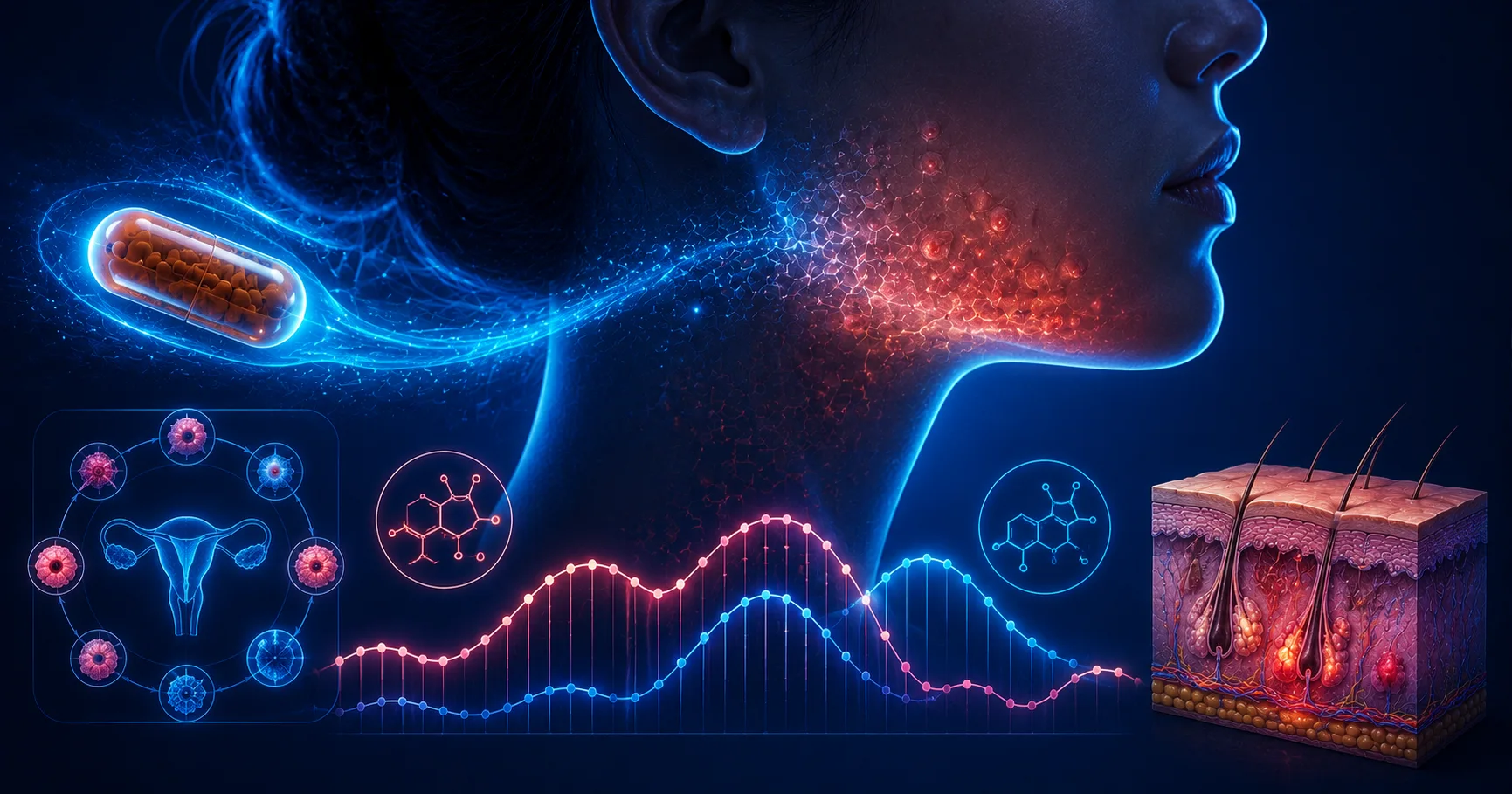
Accutane for Hormonal Acne: Does It Work for Women?
Learn how accutane for hormonal acne works mechanistically, why women relapse more often, the 120–150 mg/kg dose threshold, and when dermatologists add spironolactone.
Why Sebum — Not Hormones — Is What Isotretinoin Actually Targets
If you have jawline breakouts that flare the week before your period, you have almost certainly heard two things: "that's hormonal acne" and "Accutane will fix it." Both statements are true — but incomplete in a way that matters enormously for whether your results last. Understanding accutane for hormonal acne means understanding what isotretinoin actually does at the cellular level, and what it deliberately leaves alone.
Isotretinoin does not lower your testosterone. It does not reduce your DHT. It does not change your hormonal blood panel in any meaningful way. Clinical studies consistently show serum androgen levels remain unchanged during and after a full course of isotretinoin. What the drug does instead is target the sebaceous gland — the oil-producing structure in your skin that androgens use to trigger acne in the first place.
Here is the mechanism in plain terms: androgens — primarily testosterone and DHT — bind to receptors in sebaceous glands and instruct them to produce more sebum. Excess sebum is the medium through which hormonal signals create clogged follicles, bacterial overgrowth, and the inflammation that becomes a pimple. Accutane attacks that medium directly. After just 8 weeks of treatment, sebaceous glands shrink by approximately 50%. Sebum production drops by up to 90% during an active course.
So yes — isotretinoin hormonal acne treatment works. But it works by eliminating the downstream effect (the oil) rather than correcting the upstream cause (the hormonal signal). The hormonal trigger survives the course completely intact. That single mechanistic fact predicts everything about who clears permanently and who relapses.
What This Means for Your Treatment
For most patients, this distinction does not matter. Sebaceous glands stay suppressed long after the course ends, and acne does not return. For women with strong ongoing hormonal drivers — elevated androgens, PCOS, significant pre-menstrual flares — the glands can re-enlarge once treatment stops. The same androgen-driven sebum production restarts. Location, timing, and severity often mirror the original acne almost exactly.
This is not a treatment failure. It is a predictable biological outcome of a drug that was never designed to address hormonal root causes — and knowing it ahead of time lets you plan for it.
Clinical Evidence: How Well Does Isotretinoin Clear Hormonal Patterns?
The clinical literature is consistent: accutane for hormonal acne patterns clears effectively during the active course. The harder question is durability. Relapse rates after a single isotretinoin course range from 20% to over 60%, with the wide spread explained by three variables — cumulative dose received, patient age, and sex.
Women with hormonal acne distribution (lower face, jawline, chin, with cycle-linked flares) are 1.5 to 2 times more likely to relapse after Accutane compared to men or women whose acne was primarily on the forehead and upper cheeks. A 2024–2025 PMC study confirmed that younger female patients with persistent hormonal triggers represented the largest segment requiring a second isotretinoin course.
The single most impactful factor in preventing relapse is cumulative dose. A cumulative isotretinoin dose of 120–150 mg/kg is associated with dramatically lower relapse rates compared to shorter or lower-dose courses. Many patients — particularly lighter patients treated conservatively — never reach this threshold, which is the primary reason their acne returns.
Below 100 mg/kg
High (40–60%+)
Common in short or low-dose courses
100–120 mg/kg
Moderate (25–40%)
Standard minimum target
120–150 mg/kg
Low (15–25%)
Recommended threshold for durable remission
Women with lower-face acne that worsens the week before their period carry the highest post-Accutane relapse risk. Ask your dermatologist specifically what your planned cumulative dose is and whether it will reach 120–150 mg/kg — that number is the strongest single predictor of whether your results will last.
Jawline and Chin Acne as a Specific Relapse Risk Flag
Cycle-linked jawline and chin acne is not just a pattern clinicians use to classify hormonal acne — it is a documented relapse risk indicator. Women whose acne sits exclusively on the lower face and reliably worsens 7–10 days before menstruation have demonstrably higher androgen receptor activity in those sebaceous glands. When Accutane shrinks those glands, it silences the problem. When the glands re-expand after treatment in response to the same androgen signals that were never blocked, the same lower-face, pre-menstrual pattern re-emerges with the same distribution and timing.
This is precisely the patient group where dermatologists are increasingly using post-Accutane maintenance strategies rather than simply monitoring for relapse.
The Sebaceous Gland Re-Expansion Problem Women With PCOS Face
One of the least-discussed dimensions of hormonal acne accutane women treatment is what happens to sebaceous glands after the course ends. During isotretinoin treatment, glands shrink by approximately 50% and sebum production drops by up to 90%. For most patients, this reduction is sustained — glands do not fully return to their pre-treatment size even years after stopping.
For women with ongoing hormonal excess — whether from PCOS, elevated free testosterone, or strong androgen sensitivity in facial skin — the biology plays out differently. Once isotretinoin clears the body, the androgen signals that were never addressed continue operating. Sebaceous glands that remain androgen-sensitive begin responding to those signals again. Over months, gland size inches back up. Sebum production follows. By six to twelve months post-treatment, acne can return with the same distribution and timing as before treatment began.
This is the core biology behind why accutane pcos acne has a substantially higher relapse rate than acne in patients without polycystic ovarian syndrome. PCOS typically involves elevated testosterone, elevated free testosterone, or elevated DHEA-S — androgens that persist entirely unchanged regardless of isotretinoin use. A drug that does not alter androgen levels cannot durably suppress acne in skin that remains maximally sensitive to those levels.
Understanding this before you start your course — not after your acne comes back — matters for how you plan what comes next.
Identifying Whether You Are in the High-Relapse Group
You are likely in the higher-relapse group if your acne has been located primarily on the lower face (jawline, chin, neck), if it worsens reliably in the week before your period, if you have a PCOS diagnosis or symptoms (irregular cycles, excess facial hair, difficulty losing weight), or if previous antibiotic courses cleared your skin temporarily before acne returned with the same pattern. Any of these factors, and especially their combination, should prompt a direct conversation with your dermatologist about post-Accutane strategy before you finish the course.
Accutane vs. Spironolactone for Hormonal Acne in Women
Spironolactone and isotretinoin work through completely different mechanisms, which is why comparing them requires understanding what each one actually does — and why many dermatologists no longer frame them as competing options.
Isotretinoin acts directly on the sebaceous gland, shrinking it and reducing sebum production regardless of the trigger. Spironolactone, at doses of 50–200 mg/day, blocks androgen receptors in sebaceous glands and skin tissue throughout the face. It does not eliminate oil production; it blocks the hormonal signal that drives excess oil production. The root cause is addressed at the receptor level rather than the output level.
For women with hormonally-driven acne weighing their options, here is how the two treatments compare in practice:
Reduces sebum directly
Yes — up to 90% during course
Partially, via androgen blockade
Addresses hormonal trigger
No — androgens unchanged
Yes — blocks androgen receptors
Typical duration
5–9 months (finite course)
Ongoing maintenance
Speed of clearing
Faster — dramatic within 3–4 months
Slower — 3–6 months for full effect
Best suited for
Severe, cystic, widespread acne
Mild-moderate hormonal acne; post-Accutane maintenance
Does accutane work for hormonal acne better than spironolactone? For severe, cystic, or widespread acne, isotretinoin typically produces faster and more complete initial clearing. Spironolactone's clinical strength is durability — because it addresses the hormonal root cause, maintenance can continue indefinitely without the systemic side effects of ongoing isotretinoin. The question for most women is not which to choose but whether to use them together.
When Dermatologists Use Both Treatments
An increasingly well-supported approach for women with confirmed hormonal acne patterns is sequential therapy: complete a full isotretinoin course to achieve rapid, deep clearing — then transition to spironolactone as ongoing maintenance to block the androgen receptors that Accutane left intact.
The logic is direct. Isotretinoin clears years' worth of cystic and inflammatory acne quickly and at a depth spironolactone alone rarely achieves for severe cases. Spironolactone then guards the sebaceous glands against the hormonal signals that would otherwise cause relapse. Some dermatologists start spironolactone in the final months of the isotretinoin course to create a seamless handoff, minimizing the gap in which relapse could begin.
This combined approach is particularly well-matched for accutane pcos acne — where persistent elevated androgens make post-Accutane relapse close to inevitable without hormonal intervention — and for any woman whose acne has shown a clear cycle-linked lower-face pattern throughout her history.
For women with PCOS or cycle-linked jawline acne, ask your dermatologist about combining a full 120–150 mg/kg isotretinoin course with spironolactone 50–100 mg/day as post-treatment maintenance. This two-phase approach targets sebum production during Accutane and the hormonal signal afterward — giving you the best documented chance at lasting clearance without requiring a second course.
Planning a Complete Hormonal Acne Strategy From the Start
For a woman with moderate-to-severe hormonal acne, a well-structured treatment plan based on current evidence includes several elements working together — not a single drug and a follow-up appointment three months after stopping.
First, a full isotretinoin course reaching 120–150 mg/kg cumulative dose. This is not always offered by default. Some prescribers cap treatment earlier, especially for lighter patients, which puts them below the threshold associated with durable remission. Knowing this number gives you the language to have a meaningful conversation about your treatment duration before you start.
Second, documentation of your acne pattern before and during treatment. Monthly photos, a note of when in your cycle flares occur, and tracking of exactly where new breakouts appear give your dermatologist concrete data to assess your individual relapse risk — and to make the case for post-treatment maintenance based on your specific pattern rather than a general recommendation.
Third, a post-Accutane conversation that happens before you finish the course, not after relapse. If your acne has been cycle-linked and lower-face dominant throughout your history, the evidence places you in the higher-relapse group. Spironolactone, combined oral contraceptives chosen for androgen-blocking profiles, or both, are appropriate maintenance options that your dermatologist can discuss in the context of your hormonal history and goals.
For women where accutane for hormonal acne produced a full clear that subsequently relapsed within 12 months, a second course combined with hormonal management is supported by the clinical literature. The 2024–2025 PMC findings on young female patients requiring retreatment underscore that this is a documented, predictable pattern — not a personal failure or evidence that treatment does not work.
Isotretinoin hormonal acne treatment is most effective when it is the beginning of a coordinated strategy, not the end of one.
Frequently Asked Questions
Yes. Accutane for hormonal acne works by reducing sebum production by up to 90% during treatment, clearing even stubborn lower-face and cystic breakouts. However, it does not change hormone levels or block androgen receptors. Women with cycle-linked, jawline-dominant acne face a 1.5–2x higher relapse risk than patients with non-hormonal acne patterns.
For severe or cystic acne, isotretinoin clears faster and more completely. Spironolactone addresses the hormonal root cause by blocking androgen receptors, making it superior for long-term maintenance. Many dermatologists now prescribe isotretinoin for initial clearing, then add spironolactone at 50–100 mg/day as post-treatment maintenance to prevent relapse in women with cycle-driven acne.
Accutane shrinks sebaceous glands and suppresses sebum production but does not alter the hormonal signals that drive oil production. In women with elevated androgens or PCOS, glands can re-enlarge once treatment ends. Reaching the 120–150 mg/kg cumulative dose lowers this risk significantly, but women with active hormonal triggers remain at elevated relapse risk without hormonal maintenance.
No. Clinical data consistently shows serum testosterone, DHT, and other androgen markers remain completely unchanged during and after isotretinoin treatment. Accutane works downstream on the sebaceous gland itself — not upstream on hormone production or receptor signaling. This is why women with persistent hormonal acne can clear completely on isotretinoin and still relapse if their androgen levels remain elevated.
Some dermatologists prescribe both, particularly toward the end of an Accutane course or immediately after it ends, to prevent hormonal relapse in women. There is no established contraindication to concurrent use, but both require monitoring — isotretinoin through the iPLEDGE program and spironolactone for potassium levels and blood pressure. The timing and dose combination should be determined with your prescribing dermatologist.
Yes — Accutane clears chin and jawline acne effectively during the active course. However, lower-face acne concentrated on the jawline and chin is the primary hormonal distribution pattern, and women with this location paired with pre-menstrual flares are among those most likely to relapse after stopping. A full 120–150 mg/kg cumulative dose and a post-treatment maintenance plan are especially important for this group.
Accutane.org is an independent educational resource. We are not affiliated with any pharmaceutical manufacturer or healthcare provider. This content is for informational purposes only and does not constitute medical advice.
Editorial Team
Comments (0)
Be the first to comment on this article.